Buy fotoworkshops.eu ?
We are moving the project
fotoworkshops.eu .
Are you interested in purchasing the domain
fotoworkshops.eu ?
domain@kv-gmbh.de · 0541-91531010
Buy fotoworkshops.eu ?
What lighting is ideal for a workshop?
The ideal lighting for a workshop is bright, even, and consistent. This can be achieved with overhead LED lights or fluorescent fixtures to provide ample illumination for detailed tasks. It's also important to have adjustable task lighting for specific work areas, such as desk lamps or portable work lights. Additionally, natural light from windows or skylights can help to reduce eye strain and create a more comfortable working environment. **
Why won't the lens of Nikon D3000 focus?
There could be several reasons why the lens of a Nikon D3000 won't focus. It could be due to a dirty or smudged lens, a malfunctioning autofocus system, or a problem with the camera's settings. Additionally, the lens may not be properly attached to the camera body, or there could be a mechanical issue with the lens itself. It's important to troubleshoot and eliminate these potential issues to determine the exact cause of the focusing problem. **

Similar search terms for Hydrotherapy
Top-Angebote
Products related to Hydrotherapy:
-
Pepin Press The Landscape Photography Workshop - A Complete Guide To Understanding Light And Composition - Non Fiction - PaperbackTitle:. The Landscape Photography Workshop Format: Paperback Overview:. The Landscape Photography Workshop stands as an essential resource for anyone dedicated to capturing the full majesty of the natural world with intention and precision. This comprehensive paperback serves as a complete guide focused specifically on two fundamental pillars of visual excellence: understanding light and mastering composition. Photographers frequently struggle with the unpredictable nature of outdoor illumination or feel overwhelmed when trying to arrange complex elements within the frame. This title addresses those challenges directly, offering a structured approach to developing a photographer's eye through systematic analysis and practical application. By exploring how light behaves across different environments and shifts throughout the day, readers gain the ability to anticipate conditions rather than simply react to them. Similarly, the rigorous focus on composition provides actionable frameworks for organizing scenes to create balance, depth, and emotional resonance. Whether you are setting up your gear for a dramatic sunrise shot or adjusting the angle of your lens during a flat afternoon, this guide ensures every technical and artistic decision brings you closer to a compelling image. It bridges the gap between technical knowledge and expressive artistry, making it an invaluable tool for building a confident and consistent landscape photography practice. What Makes This Book Stand Out:. What distinguishes this work is its relentless focus on the interplay between light and shape, integrating them seamlessly rather than treating these topics in isolation. Most guides address illumination and framing separately, but this title demonstrates how directional sunlight can enhance texture while simultaneously requiring adjustments to compositional weight. The emphasis remains grounded in real-world application, guiding users to recognize patterns in nature and apply geometric principles intuitively. It moves beyond rigid adherence to classical rules, teaching when and why to employ techniques such as leading lines, foreground interest, and dynamic symmetry to serve the narrative rather than restrict it. Readers will appreciate the dedication to natural light analysis, which equips shooters with the skills needed to thrive in challenging climates and produce beautiful results even when ideal conditions cannot be recreated. Additionally, the embedded workshop principles encourage iterative practice, prompting readers to revisit concepts with fresh perspectives and reinforcing retention through repeated engagement with the material in the field. The logical progression of topics mirrors a professional curriculum, ensuring foundational skills are solidified before advancing to nuanced techniques. This approach builds confidence gradually, reducing the intimidation factor often associated with dense theoretical literature and making professional-grade concepts...16,99 £*Shipping: 2,99 £Secure redirect to the provider
-
Multicon Wholesale Hub Grille Shutter Radiator Shutter Assembly Direct Fit grille Shutter Radiator Shutter Assembly Direct FitRevitalize your trucks performance with a precisionengineered grille upgrade that keeps your engine running smoother and longer. This Radiator Shutter Assembly is designed for drivers who demand reliable airflow control and enhanced cooling...164,97 $*Shipping: 0,00 $Secure redirect to the provider
-
Asus AUSDOM AF640 1080P Webcam Auto Focus with Noise Cancelling Microphone Super Wide Angle LensAUSDOM AF640 1080P Webcam Auto Focus with Noise Cancelling Microphone Super Wide Angle Lens Never Miss Any Details: Full HD 1080P with max resolution up to 1920 x 1080 pixels, easy to make HD video calls or record video. See More Than Expect: Super HD wide-angle lens achieves a wider field of view and wider-range coverage Noise Reduction Mic: Filter out external background noise, and make you heard very clearly. Fast and Accurate Autofocus: Make the camera will automatically stay focused on your face even if you move around. Wide Compatibility: Windows XP, Windows 7, Windows 8, Windows 10, Android V5.0 or updated version, Mac OS 10.6 or updated version. Specifications: F/No.: 2.0 View Angle: Horizontal 90° MIC.: Built-in S.P.L: -36dB Directivity: Omni-directional Sensor: 1/2.7” COMS Image Sensor Interface: USB 2.0 (Free Driver) Power Consumption: ≤260mAh Support OS (UVC): Windows XP/7/8/10 or updated version, Mac OS 10.6 or updated version, Chrome OSTM, Android v5.0 or above Photo Resolution: 1920*1080 Video Resolution (Video mode: YUY2): Max Resolution: 1980*1080 30fps Min. Resolution: 320*240 30fps Default: 640*480 30fps Video Resolution (Video mode: MJPG): Max Resolution: 2048*1536 30fps Min. Resolution: 160*120 30fps Default: 1280*720 30fps Photo Format: JPG Operating Temp.: -10°C-50°C49,99 £*Shipping: 0,00 £Secure redirect to the provider
-
NIVEA SUN set for sun exposureNIVEA SUN, 0 , After-Sun Care for Women, Everything for beautiful-looking skin all in one package. The NIVEA SUN beauty gift set contains not one but several products to help you create or enrich your daily beauty routine and make you or your loved ones happy to receive it as a gift. The set contains: NIVEA SUN Protect & Dry Touch invisible sun spray SPF 50 200 ml NIVEA SUN After Sun moisturising after sun lotion with aloe vera 400 ml Characteristics: for a comprehensive skin care routine protects skin against UVA and UVB radiation gives skin the hydration it needs provides deep nourishment to sun-stressed skin a set at a favourable price How to use: Use every product from the cosmetic set according to the instructions.20,10 £*Shipping: 3,99 £Secure redirect to the provider


-
Why is the lens focus ring not turning?
The lens focus ring may not be turning due to a mechanical issue such as a jammed or broken mechanism within the lens. It could also be due to a software issue, such as the camera not being properly connected to the lens or a malfunction in the autofocus system. Additionally, the lens may be in manual focus mode, which would prevent the focus ring from turning when using autofocus. It's important to troubleshoot the issue by checking the camera and lens settings, as well as inspecting the physical condition of the lens for any visible damage. If the issue persists, it may be necessary to seek professional repair or replacement of the lens. **
-
How to focus a manual lens on a gimbal?
To focus a manual lens on a gimbal, you will need to adjust the focus ring on the lens itself. Start by setting your camera to manual focus mode. Use the gimbal's controls to stabilize the camera and frame your shot. Then, carefully turn the focus ring on the lens until your subject is in sharp focus. It may take some practice to get the hang of smoothly adjusting the focus while using a gimbal, but with patience and practice, you will be able to achieve crisp, focused shots. **
-
How do you adjust the focus on a lens?
To adjust the focus on a lens, you typically rotate the focus ring on the lens barrel. Turn the ring clockwise or counterclockwise until the subject appears sharp in the viewfinder or on the camera's LCD screen. You can also use the camera's autofocus system to automatically adjust the focus by half-pressing the shutter button or using a designated autofocus button. Additionally, some lenses have a switch to toggle between autofocus and manual focus modes, allowing you to manually adjust the focus by rotating the focus ring. **
-
What is the difference between shutter speed and exposure time on a camera?
Shutter speed and exposure time are often used interchangeably, but they refer to slightly different concepts in photography. Shutter speed specifically refers to the amount of time the camera's shutter remains open to allow light to hit the camera sensor, measured in fractions of a second (e.g., 1/1000s). Exposure time, on the other hand, encompasses the total duration of time the sensor is exposed to light, including the time the shutter is open and any additional delay before or after the exposure. In practical terms, both terms are crucial in determining the amount of light that reaches the sensor and ultimately affects the brightness and sharpness of the image. **


What is the difference between shutter speed and exposure time in a camera?
Shutter speed and exposure time are often used interchangeably, but they actually refer to different aspects of a camera's operation. Shutter speed specifically refers to the amount of time the camera's shutter remains open to allow light to reach the camera's sensor, typically measured in fractions of a second. Exposure time, on the other hand, refers to the total duration of time that the camera's sensor is exposed to light, including both the time the shutter is open and any additional time the sensor may be active to capture the image. In essence, shutter speed is a specific aspect of exposure time, with the latter encompassing the entire duration of light exposure for a given photograph. **
What is the infinite focus on a 50mm 1.8f lens?
The infinite focus on a 50mm 1.8f lens refers to the point at which objects at an infinite distance appear sharp and in focus when the lens is set to its minimum focusing distance. This setting is commonly used for landscape photography or when capturing distant subjects. By setting the lens to infinite focus, photographers can ensure that objects in the distance are sharp and clear in their images. **
Top-Angebote
Products related to Hydrotherapy:
-
Ross Hoddinott Digital Exposure Handbook, Landscape Photography Workshop 2 Books Collection Set - Non Fiction - PaperbackTitles in This Set:. Digital Exposure Handbook (Revised Edition). Landscape Photography Workshop Condition: BRAND NEW. Format: Paperback. ISBN: 9781907708978 9781907708954 Overview:. Two of the UK's leading landscape photographers come together to share their wealth of experience in this essential two-book collection. The Digital Exposure Handbook (Revised Edition) demystifies exposure, turning what can feel like a mystery into practical, field-ready guidance. You’ll learn how to approach exposure with confidence, understand how light interacts with your sensor, and translate that knowledge into cleaner, more trading images on location. Paired with Landscape Photography Workshop, which guides you from the very basics of equipment and exposure through to more advanced techniques, this set covers composition, filtration, and light with clear, approachable instruction. Together, these books form a complete learning journey designed for real-world shooting—from dawn-lit coastlines to rugged mountains. The portable paperback format makes every field trip easier, and the practical exercises help you implement what you learn immediately, turning theory into striking, memorable landscapes. A compact, authoritative duo for beginners and seasoned shooters alike. What Makes This Collection Special:. What makes this collection stand out is the complementary pairing of two practical guides that build a reader’s capabilities step by step. The Digital Exposure Handbook provides a solid foundation in how exposure really works—without jargon—so you can predict results rather than rely on guesswork. The Landscape Photography Workshop then translates that knowledge into genre-specific techniques: how to frame vast skies, how to manage depth of field across expansive scenes, and how to use filtration to control contrast and mood. Written by two of the UK’s most respected landscape photographers, the set offers a coherent reading path, consistent terminology, and a shared design aesthetic that makes it easy to reference on location. It’s a true end-to-end learning kit for landscape storytelling. Books Included in This Collection:. Digital Exposure Handbook (Revised Edition). This revised edition unpacks exposure in a straightforward, field-friendly way. It guides you through how to evaluate light, adjust camera settings, and make deliberate creative choices that preserve detail and tone. With practical exercises and real-world examples, the book helps you move beyond theory into reliable in-the-field results, whether you’re shooting coastal dawns, moody moors, or tranquil lakes. The emphasis is on understanding exposure as a tool for creative expression, not a barrier to taking better photos. Landscape Photography Workshop. This companion volume takes you from the ground up—starting with essential gear and shooting fundamentals, then advancing to composition, framing, and the nuanced use of filters. You’ll explore how to read landscapes, select vantage points, and...24,99 £*Shipping: 2,99 £Secure redirect to the provider
-
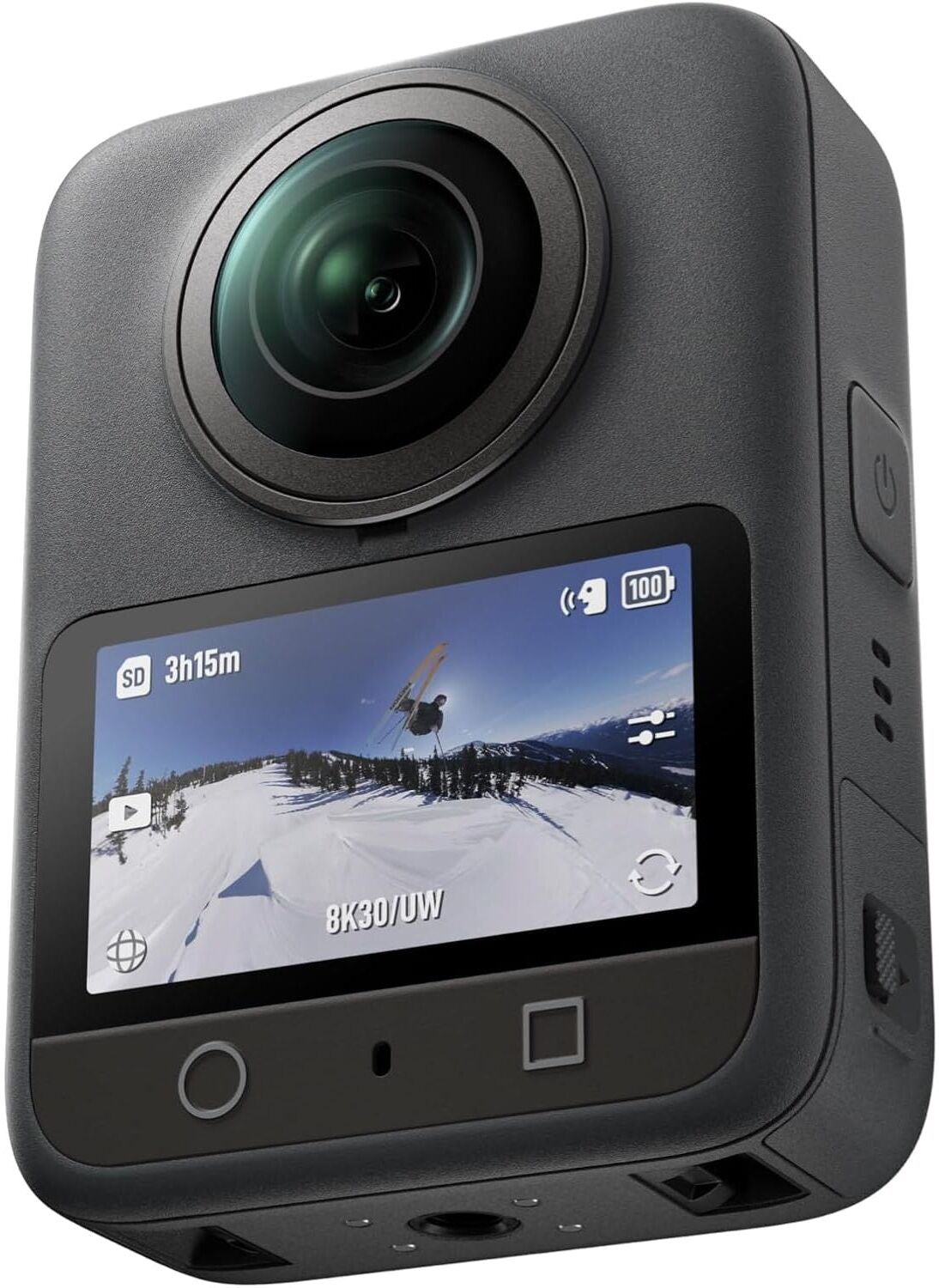
Eclat Tech Ltd DJI Osmo Action 360 Standard Combo Action Camera – 360° Capture, Dual-Lens, Stabilised VideoThe DJI Osmo Action 360 Standard Combo is a versatile action camera designed to capture immersive 360° footage with stunning clarity. Featuring dual-lens technology and advanced stabilisation, it allows you to record every angle of your adventure in smooth, cinematic detail. Built for durability and ease of use, it’s perfect for content creators, travellers, and outdoor enthusiasts who want to elevate their video experience. Key Features 360° dual-lens capture for fully immersive video and photos High-resolution recording for sharp, detailed footage Advanced stabilisation for smooth, shake-free videos Rugged, waterproof design for outdoor and action use Dual touchscreen displays for easy framing and control Wide field of view for dynamic and creative shots Intelligent shooting modes for creative flexibility Wi-Fi and Bluetooth connectivity for quick sharing Long-lasting battery for extended recording sessions Compact and portable design for on-the-go use Benefits The DJI Osmo Action 360 allows you to capture every moment from all angles, eliminating the need to worry about framing. Its stabilisation ensures smooth footage even in high-motion environments, while the durable build makes it suitable for extreme conditions. With easy controls and wireless connectivity, it simplifies content creation and sharing. Whether you’re filming adventures or creating social media content, it delivers immersive and professional-quality results. Specifications Specification Details Model DJI Osmo Action 360 EAN 6937224110502 Camera Type 360° Action Camera Lens Type Dual Lens Video Resolution High-resolution (varies by mode)* Stabilisation Advanced Electronic Stabilisation Display Dual Touchscreens Connectivity Wi-Fi, Bluetooth Waterproof Yes Battery Rechargeable Lithium-Ion Colour Black *Exact resolution depends on shooting mode and settings. What you’ll receive DJI Osmo Action 360 Camera Battery Mounting Frame Adhesive Mount USB-C Charging Cable Quick Release Adapter User Documentation399,00 £*Shipping: 0,00 £Secure redirect to the provider
-
Pepin Press The Landscape Photography Workshop - A Complete Guide To Understanding Light And Composition - Non Fiction - PaperbackTitle:. The Landscape Photography Workshop Format: Paperback Overview:. The Landscape Photography Workshop stands as an essential resource for anyone dedicated to capturing the full majesty of the natural world with intention and precision. This comprehensive paperback serves as a complete guide focused specifically on two fundamental pillars of visual excellence: understanding light and mastering composition. Photographers frequently struggle with the unpredictable nature of outdoor illumination or feel overwhelmed when trying to arrange complex elements within the frame. This title addresses those challenges directly, offering a structured approach to developing a photographer's eye through systematic analysis and practical application. By exploring how light behaves across different environments and shifts throughout the day, readers gain the ability to anticipate conditions rather than simply react to them. Similarly, the rigorous focus on composition provides actionable frameworks for organizing scenes to create balance, depth, and emotional resonance. Whether you are setting up your gear for a dramatic sunrise shot or adjusting the angle of your lens during a flat afternoon, this guide ensures every technical and artistic decision brings you closer to a compelling image. It bridges the gap between technical knowledge and expressive artistry, making it an invaluable tool for building a confident and consistent landscape photography practice. What Makes This Book Stand Out:. What distinguishes this work is its relentless focus on the interplay between light and shape, integrating them seamlessly rather than treating these topics in isolation. Most guides address illumination and framing separately, but this title demonstrates how directional sunlight can enhance texture while simultaneously requiring adjustments to compositional weight. The emphasis remains grounded in real-world application, guiding users to recognize patterns in nature and apply geometric principles intuitively. It moves beyond rigid adherence to classical rules, teaching when and why to employ techniques such as leading lines, foreground interest, and dynamic symmetry to serve the narrative rather than restrict it. Readers will appreciate the dedication to natural light analysis, which equips shooters with the skills needed to thrive in challenging climates and produce beautiful results even when ideal conditions cannot be recreated. Additionally, the embedded workshop principles encourage iterative practice, prompting readers to revisit concepts with fresh perspectives and reinforcing retention through repeated engagement with the material in the field. The logical progression of topics mirrors a professional curriculum, ensuring foundational skills are solidified before advancing to nuanced techniques. This approach builds confidence gradually, reducing the intimidation factor often associated with dense theoretical literature and making professional-grade concepts...16,99 £*Shipping: 2,99 £Secure redirect to the provider
-
Multicon Wholesale Hub Grille Shutter Radiator Shutter Assembly Direct Fit grille Shutter Radiator Shutter Assembly Direct FitRevitalize your trucks performance with a precisionengineered grille upgrade that keeps your engine running smoother and longer. This Radiator Shutter Assembly is designed for drivers who demand reliable airflow control and enhanced cooling...164,97 $*Shipping: 0,00 $Secure redirect to the provider
-
What lighting is ideal for a workshop?
The ideal lighting for a workshop is bright, even, and consistent. This can be achieved with overhead LED lights or fluorescent fixtures to provide ample illumination for detailed tasks. It's also important to have adjustable task lighting for specific work areas, such as desk lamps or portable work lights. Additionally, natural light from windows or skylights can help to reduce eye strain and create a more comfortable working environment. **
-
Why won't the lens of Nikon D3000 focus?
There could be several reasons why the lens of a Nikon D3000 won't focus. It could be due to a dirty or smudged lens, a malfunctioning autofocus system, or a problem with the camera's settings. Additionally, the lens may not be properly attached to the camera body, or there could be a mechanical issue with the lens itself. It's important to troubleshoot and eliminate these potential issues to determine the exact cause of the focusing problem. **
-
Why is the lens focus ring not turning?
The lens focus ring may not be turning due to a mechanical issue such as a jammed or broken mechanism within the lens. It could also be due to a software issue, such as the camera not being properly connected to the lens or a malfunction in the autofocus system. Additionally, the lens may be in manual focus mode, which would prevent the focus ring from turning when using autofocus. It's important to troubleshoot the issue by checking the camera and lens settings, as well as inspecting the physical condition of the lens for any visible damage. If the issue persists, it may be necessary to seek professional repair or replacement of the lens. **
-
How to focus a manual lens on a gimbal?
To focus a manual lens on a gimbal, you will need to adjust the focus ring on the lens itself. Start by setting your camera to manual focus mode. Use the gimbal's controls to stabilize the camera and frame your shot. Then, carefully turn the focus ring on the lens until your subject is in sharp focus. It may take some practice to get the hang of smoothly adjusting the focus while using a gimbal, but with patience and practice, you will be able to achieve crisp, focused shots. **
Similar search terms for Hydrotherapy
-
Asus AUSDOM AF640 1080P Webcam Auto Focus with Noise Cancelling Microphone Super Wide Angle LensAUSDOM AF640 1080P Webcam Auto Focus with Noise Cancelling Microphone Super Wide Angle Lens Never Miss Any Details: Full HD 1080P with max resolution up to 1920 x 1080 pixels, easy to make HD video calls or record video. See More Than Expect: Super HD wide-angle lens achieves a wider field of view and wider-range coverage Noise Reduction Mic: Filter out external background noise, and make you heard very clearly. Fast and Accurate Autofocus: Make the camera will automatically stay focused on your face even if you move around. Wide Compatibility: Windows XP, Windows 7, Windows 8, Windows 10, Android V5.0 or updated version, Mac OS 10.6 or updated version. Specifications: F/No.: 2.0 View Angle: Horizontal 90° MIC.: Built-in S.P.L: -36dB Directivity: Omni-directional Sensor: 1/2.7” COMS Image Sensor Interface: USB 2.0 (Free Driver) Power Consumption: ≤260mAh Support OS (UVC): Windows XP/7/8/10 or updated version, Mac OS 10.6 or updated version, Chrome OSTM, Android v5.0 or above Photo Resolution: 1920*1080 Video Resolution (Video mode: YUY2): Max Resolution: 1980*1080 30fps Min. Resolution: 320*240 30fps Default: 640*480 30fps Video Resolution (Video mode: MJPG): Max Resolution: 2048*1536 30fps Min. Resolution: 160*120 30fps Default: 1280*720 30fps Photo Format: JPG Operating Temp.: -10°C-50°C49,99 £*Shipping: 0,00 £Secure redirect to the provider
-
NIVEA SUN set for sun exposureNIVEA SUN, 0 , After-Sun Care for Women, Everything for beautiful-looking skin all in one package. The NIVEA SUN beauty gift set contains not one but several products to help you create or enrich your daily beauty routine and make you or your loved ones happy to receive it as a gift. The set contains: NIVEA SUN Protect & Dry Touch invisible sun spray SPF 50 200 ml NIVEA SUN After Sun moisturising after sun lotion with aloe vera 400 ml Characteristics: for a comprehensive skin care routine protects skin against UVA and UVB radiation gives skin the hydration it needs provides deep nourishment to sun-stressed skin a set at a favourable price How to use: Use every product from the cosmetic set according to the instructions.20,10 £*Shipping: 3,99 £Secure redirect to the provider
-
How do you adjust the focus on a lens?
To adjust the focus on a lens, you typically rotate the focus ring on the lens barrel. Turn the ring clockwise or counterclockwise until the subject appears sharp in the viewfinder or on the camera's LCD screen. You can also use the camera's autofocus system to automatically adjust the focus by half-pressing the shutter button or using a designated autofocus button. Additionally, some lenses have a switch to toggle between autofocus and manual focus modes, allowing you to manually adjust the focus by rotating the focus ring. **
-
What is the difference between shutter speed and exposure time on a camera?
Shutter speed and exposure time are often used interchangeably, but they refer to slightly different concepts in photography. Shutter speed specifically refers to the amount of time the camera's shutter remains open to allow light to hit the camera sensor, measured in fractions of a second (e.g., 1/1000s). Exposure time, on the other hand, encompasses the total duration of time the sensor is exposed to light, including the time the shutter is open and any additional delay before or after the exposure. In practical terms, both terms are crucial in determining the amount of light that reaches the sensor and ultimately affects the brightness and sharpness of the image. **
-
What is the difference between shutter speed and exposure time in a camera?
Shutter speed and exposure time are often used interchangeably, but they actually refer to different aspects of a camera's operation. Shutter speed specifically refers to the amount of time the camera's shutter remains open to allow light to reach the camera's sensor, typically measured in fractions of a second. Exposure time, on the other hand, refers to the total duration of time that the camera's sensor is exposed to light, including both the time the shutter is open and any additional time the sensor may be active to capture the image. In essence, shutter speed is a specific aspect of exposure time, with the latter encompassing the entire duration of light exposure for a given photograph. **
-
What is the infinite focus on a 50mm 1.8f lens?
The infinite focus on a 50mm 1.8f lens refers to the point at which objects at an infinite distance appear sharp and in focus when the lens is set to its minimum focusing distance. This setting is commonly used for landscape photography or when capturing distant subjects. By setting the lens to infinite focus, photographers can ensure that objects in the distance are sharp and clear in their images. **
* All prices are inclusive of VAT and, if applicable, plus shipping costs. The offer information is based on the details provided by the respective shop and is updated through automated processes. Real-time updates do not occur, so deviations can occur in individual cases. ** Note: Parts of this content were created by AI.